
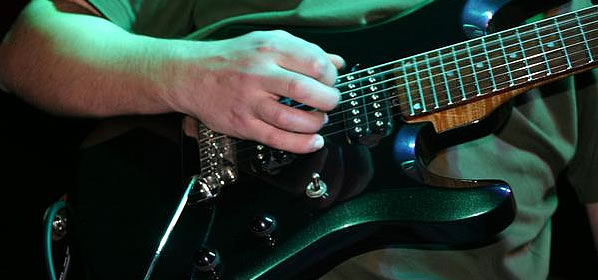
Playing over changes is the term used to describe improvising over various chords that aren’t all contained within the same key. This is often associated with jazz, as many jazz tunes constantly change key. This is considered by many to be the most challenging thing to do in improvising regardless of the instrument you play. However, I believe that with the correct instruction and methodical approach, it’s well within anyone’s capability.
…The aim of this lesson is to understand how to change key in one area of the neck…
Lewis Turner
To be able to play over changes convincingly you will need to know your fretboard inside out. This means making sure you have all your scales and arpeggios down.
In this first lesson we will be playing over two minor 7 chords a minor 3rd apart: Am7 and Cm7, with each chord lasting one bar. As these two chords are minor and a minor 3rd apart, there is no one scale that can be used to fit other both. The aim of this lesson is to understand how to change key in one area of the neck.
I have used two scales for all the examples; the minor pentatonic, and Dorian. The minor pentatonic scale is the classic scale of choice over a minor chord, here it is used in a more modern fusion way rather than blues. Dorian is the second mode of the major scale and is often used over a minor 7 chord, as the major 6th note in this scale gives a very jazzy feel.
If you look at the end of the transcription you will find the scale shapes that I have used. Over the Am7 chord we have both minor pentatonic and Dorian in shape one. Over the Cmin7 chord both scale shapes are shape five. This means one only covers a very small amount of fretboard area.
As you start to play over more chords this is an essential skill to have, as it prevents you from having to jump all over the fretboard, and your lines will keep their continuity. Here is a good scale practice exercise you can try; play the following progression in one area of the fretboard, say 5 – 8th fret: A,C,D,F and G. Now play the corresponding major scale for each chord staying within that area (used the CAGED system if you know it). Now repeat the process changing all the chords to minor, you could also play arpeggios, Maj7, min7, dom7 etc. Do this in all five areas of the fretboard. If you do this every day your fretboard knowledge will increase dramatically.
I have used very basic rhythm on these lines just so you can get used to playing the scale shapes. Over the backing track try the lines I have written, but more importantly improvise and try your own ideas. Enjoy it and good luck!
| Resources for the Playing Over Changes tutorial – © Lewis Turner | |
|---|---|
 |
Guitar Jar Lesson – Guitar licks over Minor 7 changes (110KB pdf) |
 |
Guitar Jar Lesson – Playing Over Changes – Complete Track (1.9MB MP3) |
|
Audio clip: Adobe Flash Player (version 9 or above) is required to play this audio clip. Download the latest version here. You also need to have JavaScript enabled in your browser. |
|
|
Guitar Jar Lesson – Playing Over Changes – Backing Track (1.9MB MP3) |
|
Audio clip: Adobe Flash Player (version 9 or above) is required to play this audio clip. Download the latest version here. You also need to have JavaScript enabled in your browser. |
|
All content © Lewis Turner – For more information about Lewis Turner, please visit:
 Win free professional tablature courtesy of mySongBook
 eBook – New Approach to Scales
 Guitar Lesson: Modes Lesson #1 – Ionian
 Guitar Lesson: “Jar of Hearts” by Christina Perri
 Guitar Lesson: Diminished Scale Concepts
Guitar Lesson: Diminished Sounds Applied to the Guitar Fingerboard
Guitar Lesson: Diminished Scale Concepts
Guitar Lesson: Diminished Sounds Applied to the Guitar Fingerboard
 DVD Review: John Abercrombie & Greg Osby – Solos The Jazz Sessions
Guitar Lesson – Artist Profile: Yngwie Malmsteen
DVD Review: John Abercrombie & Greg Osby – Solos The Jazz Sessions
Guitar Lesson – Artist Profile: Yngwie Malmsteen
 Become a Guitar Tutor with www.MyGuitarLessons.co.uk
 Guitar Lesson: Fretting Hand Position
Guitar Lesson – Artist Profile: Allan Holdsworth
Guitar Lesson: Fretting Hand Position
Guitar Lesson – Artist Profile: Allan Holdsworth
 DVD Review: Charlie Hunter – Solos The Jazz Sessions
 Choosing the Right Guitar Teacher
Guitar Lesson: Stuck in a rut? Learn 11 New Licks
Guitar Lesson: Slurs (aka Hammer on and Pull off)
Choosing the Right Guitar Teacher
Guitar Lesson: Stuck in a rut? Learn 11 New Licks
Guitar Lesson: Slurs (aka Hammer on and Pull off)
 Learning Jazz Guitar: Method books – help or hindrance?
Guitar Lesson: Jazz Guitar Triadic Improvisation
Free Guitar Lessons
Guitar Lesson: Funk, Groove and Rhythm Timing
Guitar Lesson: Jazz soloing over the song Blue Bossa
Guitar Lesson: Metal Riffs
Guitar Lesson: Progressive Techniques – Alternate Picking Part 1
Learning Jazz Guitar: Method books – help or hindrance?
Guitar Lesson: Jazz Guitar Triadic Improvisation
Free Guitar Lessons
Guitar Lesson: Funk, Groove and Rhythm Timing
Guitar Lesson: Jazz soloing over the song Blue Bossa
Guitar Lesson: Metal Riffs
Guitar Lesson: Progressive Techniques – Alternate Picking Part 1
 Lewis Turner Interview
 Album review: The Beckoning Silence by Lewis Turner
 Top five most influential jazz guitarists

Lewis Turner is a highly accomplished guitarist, with years of performing, recording, session and teaching experience. Lewis performs all over the UK and abroad with various bands as well as Theatre, TV and Radio work

8:42:53 pm
Nice lesson. I love to change keys on the fly like that. It’s also cool how you direct people to interesting notes and wide jumps.
11:14:19 am
Thanks for the comment Matt, your website is very cool.
1:34:45 am
nice job!
I have two suggestions:
– it would be helpful to indicate which Dorian and which minor pentatonic scales you are using against the Cm7 & Am7 chords. It is helpful to refer to patterns when speaking of scales but it helps build music theory muscles to know the root names of each one.
– since you are using C and A minor 7th chords I would use flats to indicate chord tones used in the scales in your pdf instead of their enharmonic brethren, E.g. Eb instead of D# & Bb instead of A#. This conforms to the actual function of the notes contained in the chord i.e. a minor 3rd & minor 7th instead of a sharp 6th.